The Battle for Truth - Part 2 - The Integration Nightmare: When Your Data Sources Fight Each Other
A strategic guide for technology and data leaders navigating the complexity of modern data ecosystems and data in enterprise.

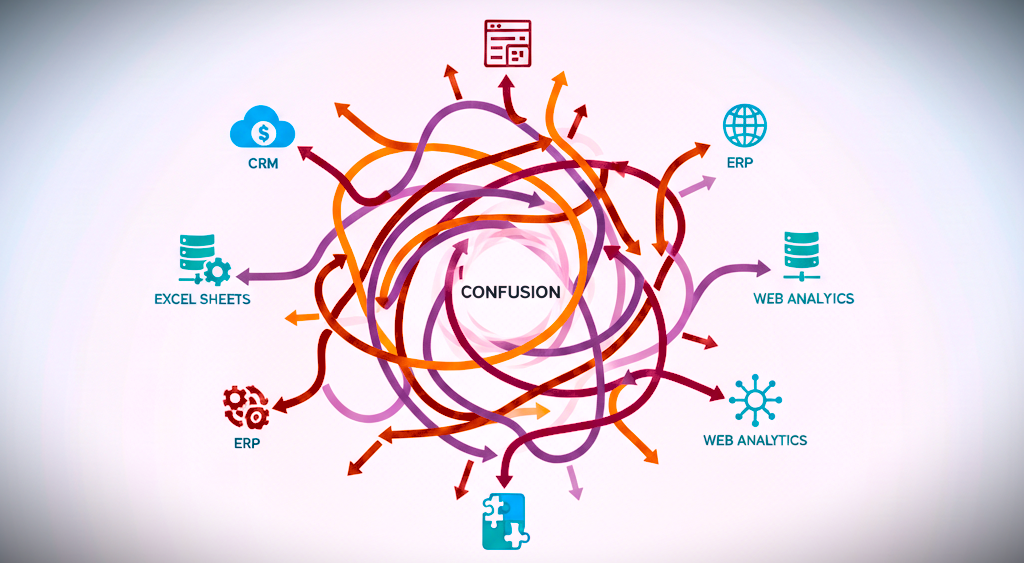
Monday morning.
Your operations team needs critical equipment data for a major project decision.
- Shop floor metrics show the pump capacity at 1,200 GPM
- The monitoring system flags an alert because its threshold is 1,350 GPM
- Production Planning lists the same pump at 1,180 GPM
Same pump. Same facility. Three different answers.
If this feels like déjà vu, you’re not alone. This is what I call the Integration Nightmare — when systems that are supposed to support decisions end up arguing with each other.
The Anatomy of Data Conflict
The Perfect Storm Scenario
Picture this: You're preparing for a quarterly board presentation. Your finance team pulls revenue data from the ERP system showing 15% growth. Marketing automation reports 18% growth from the same period. Your business intelligence dashboard – fed by both systems – shows 12% growth.
Which number do you present to the board?
This isn't a hypothetical situation. It's Monday morning reality for countless organizations that have invested heavily in digital transformation, only to discover that their sophisticated systems don't actually agree with each other.
The Faces of Integration Conflict
Timing Misalignment
Your systems update on different schedules:
- Real-time systems capture data as events occur
- Batch processing systems update overnight or weekly
- Manual entry systems depend on human schedules
Real-world impact: Your customer service team tells a client their order shipped yesterday, while your logistics system shows it's still in processing. The customer calls back confused, and your credibility takes a hit.
Definition Conflicts
Each system defines core business terms differently:
- CRM defines "customer" as anyone who's ever inquired about your services
- ERP defines "customer" as anyone who's made a purchase
- Support system defines "customer" as anyone with an active service contract
Real-world impact: Your sales team reports 500 new customers this quarter, while finance reports 300. Both are technically correct, but the disconnect creates confusion in strategic planning.
Data Transformation Errors
Information gets lost or corrupted as it moves between systems:
- Currency conversions use different exchange rates
- Unit measurements get converted incorrectly
- Date formats cause temporal misalignment
Real-world impact: Your international subsidiary reports strong performance in local currency, but the corporate consolidation system uses outdated exchange rates, making the division appear to be underperforming.
Historical Baggage: The Legacy Data Challenge
When Old Meets New
Most organizations aren't starting with a clean slate. They're trying to integrate:
- Legacy systems with decades of historical data
- Modern cloud platforms with real-time capabilities
- Manual processes that bridge the gaps
The challenge: Your 20-year-old ERP system stores customer data in formats that your new CRM can't properly interpret. But that ERP contains two decades of critical business history that you can't afford to lose.
The Migration Minefield
Data migration isn't just a technical challenge – it's an archaeological expedition:
- Inconsistent historical formats create interpretation challenges
- Business rules have evolved over time, making old data contextually different
- System limitations force compromises in data fidelity
Case study insight: A manufacturing company discovered that their "equipment weight" field had been used differently across three decades – sometimes including packaging, sometimes not, sometimes recording shipping weight instead of operational weight. Their new system needed to accommodate all three interpretations while providing consistent reporting.
The Domino Effect: How Data Conflicts Cascade
Level 1: Operational Confusion
When data sources conflict, front-line employees face impossible choices:
- Customer service representatives don't know which system to trust
- Sales teams present inconsistent information to prospects
- Operations staff make decisions based on unreliable information
Level 2: Management Paralysis
Middle management gets caught in the crossfire:
- Department heads spend meetings arguing about data accuracy instead of strategy
- Project managers delay decisions while waiting for "clean" data
- Analysts become data detectives instead of strategic advisors
Level 3: Executive Erosion
Leadership confidence in data-driven decision making erodes:
- Board presentations become exercises in data archaeology
- Strategic planning gets delayed while teams reconcile conflicting information
- Competitive responses slow down as organizations debate internal data
Level 4: Customer Impact
The ultimate cost lands on customer relationships:
- Inconsistent communications damage trust
- Service delays occur while teams verify information
- Billing errors create friction and complaints
The Hidden Organizational Costs
The Time Tax
Organizations unknowingly pay a massive "time tax" on data conflicts:
- Data analysts spend more time reconciling than analyzing
- Managers spend meetings debating data accuracy instead of strategy
- Executives delay decisions while waiting for "the real numbers"
The Confidence Crisis
When data sources consistently conflict, organizations develop "data paralysis":
- Decision makers lose confidence in data-driven insights
- Teams revert to gut-feeling decision making
- Innovation slows as organizations become risk-averse
The Competitive Disadvantage
While your organization debates which data to trust, competitors with better data governance are:
- Making faster strategic decisions
- Responding more quickly to market changes
- Delivering more consistent customer experiences
Breaking the Integration Nightmare into a Strategic Framework
Phase 1: Data Archaeology – Understanding What You Have
Map Your Data Journey
- Trace how critical business information flows through your systems
- Identify every point where data gets transformed or interpreted
- Document the business rules that govern each transformation
Audit Your Definitions
- Create a comprehensive business glossary
- Identify where the same terms mean different things
- Establish authoritative definitions for core business concepts
Assess Your Timing
- Map when each system updates its data
- Identify critical synchronization points
- Understand the business impact of timing misalignments
Phase 2: Conflict Resolution – Establishing Data Hierarchy
Create Source Authority
- Designate which system is authoritative for each type of data
- Establish clear escalation procedures for conflicts
- Implement validation rules that catch discrepancies early
Implement Business Rules
- Codify how conflicts should be resolved automatically
- Create exception handling procedures for edge cases
- Establish data quality metrics and monitoring
Design Integration Checkpoints
- Build validation into data transfer processes
- Create alerts for significant discrepancies
- Implement rollback procedures for data corruption
Phase 3: Organizational Alignment – Making Integration Sustainable
Establish Data Stewardship
- Assign clear ownership for data quality decisions
- Create cross-functional data governance teams
- Implement regular data quality reviews
Build Integration Culture
- Train teams on proper data interpretation
- Create escalation procedures for data conflicts
- Reward behaviors that improve data quality
Design for Evolution
- Build flexibility into integration processes
- Plan for future system additions and changes
- Create documentation that survives personnel changes
Immediate Actions for Integration Success (by order)
Assessment
- Identify your top 5 critical business metrics that come from multiple sources
- Check for discrepancies in how these metrics are calculated across systems
- Document the business impact of any conflicts you discover
Standardization
- Create authoritative definitions for your most critical business terms
- Establish source hierarchy for conflicting data elements
- Implement basic validation rules to catch obvious discrepancies
- Implement a basic alert system to expose issues
Governance
- Assign data stewardship roles for critical data domains
- Create escalation procedures for data quality issues
- Implement monitoring for your most critical data integration points
The Path Forward: From Nightmare to Advantage
The Integration Nightmare isn't just a technical problem – it's an organizational opportunity. Companies that solve data integration challenges don't just eliminate confusion; they create competitive advantages through:
- Faster decision making based on trusted information
- Improved customer experiences through consistent data
- Enhanced operational efficiency through reduced reconciliation time
- Stronger strategic planning based on reliable metrics
The question isn't whether you have data integration challenges – every modern organization does. The question is whether you'll address them strategically or continue to pay the hidden costs of data conflict.
Your integration nightmare can become your competitive advantage. But only if you're willing to treat it as an organizational challenge, not just a technical one.
Every integration looks straightforward on a slide, it's like connect system A to system B, align the teams and define the process, and finally set a deadline.
Simple. Right?
Until you realize that “ready” doesn’t mean the same thing to both sides.
Until one team assumes real-time data and the other planned for nightly batches.
Until “done” actually meant “done for now.”
In my experience, integration challenges are rarely about the technology itself. Most platforms can connect. Most APIs can be mapped. The real friction shows up in timing assumptions, ownership gaps, and conflicting definitions.
I’ve seen projects stall not because the solution was wrong, but because expectations were never fully aligned. Everyone thought they were on the same page. They just weren’t reading the same version.
The hardest part of integration isn’t wiring systems together. It’s aligning people, language, and assumptions before the wiring even starts.
What has been the toughest integration challenge in your experience?
Was it timing, definitions, ownership — or something completely different?
I’m genuinely curious what patterns others are seeing.
Next week in our "The Battle for Truth: Navigating Data's Critical Pain Points Across the Enterprise" series: The Scope Trap – Why unclear requirements kill data projects before they start.
Previously in this series: The Battle for Truth – Part 1: The Master Data Maze.
#DataManagement #DataGovernance #DataIntegration #MasterData #DataStrategy #DigitalTransformation #DataQuality