The Battle for Truth - Part 1: The Master Data Maze: Why Multiple Sources Create More Confusion Than Clarity
A strategic guide for technology and data leaders navigating the complexity of modern data ecosystems and data in enterprise.

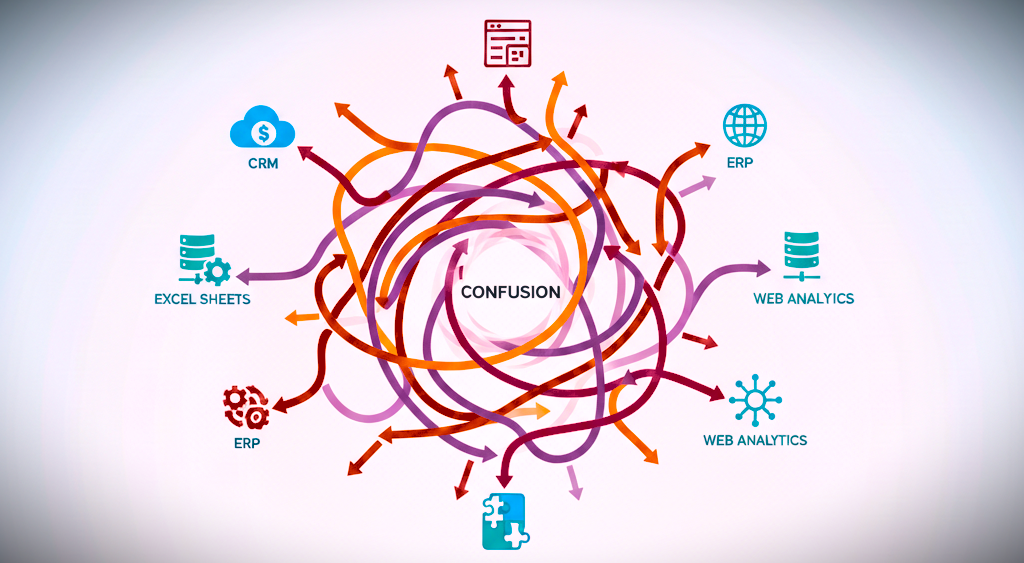
Key Points:
- The Problem: Multiple data sources without clear hierarchy.
- Real Impact: Decision paralysis, complex implementation and inconsistent reporting.
- The Hidden Cost: Your data teams spend more time debating which data to trust than actually using it.
Your team has data from ERP (Enterprise Resource Planning), CRM (Customer Relationship Management), OMS (Order Management Systems), IoT (Internet of Things) devices, internal systems, and data lakes built on open table formats like Iceberg, Delta, Hive. Which one do you trust? If you're unsure, you're not alone.
The Million-Dollar Question
Picture this scenario: You're in a meeting room, and the main topic is a critical infrastructure investment proposal. The CFO asks about the metrics used to specify the solution. The Sales team quotes Salesforce data showing one value, the Finance team presents another value (the sum of the R3 and S4 data), and the data engineering team managing the internal systems reports yet another value, which contradicts both sources.
Sound familiar? Welcome to the Master Data Maze, a labyrinth that's costing organizations thousands, millions, or more every year in delayed decisions, missed opportunities, and poor-quality data.
The Hidden Crisis in Data Leadership
As CTOs, CDOs, and CEOs, we've invested heavily in digital transformation. We've implemented sophisticated systems, hired data scientists, and built impressive dashboards. Yet, many of us are still struggling with a fundamental question: Which data should we trust?
Recent research reveals a staggering reality:
According to Gartner's 2024 Data Quality Survey:
- 60% of organizations report poor data quality impacts business outcomes.
- Average cost of poor data quality: $12.9 million annually.
Forrester's Data Management Report (2024) found:
- 47% of newly created data records contain at least one critical error.
- Organizations spend 30% of revenue managing poor data quality.
Anatomy of the Master Data Maze
The Three-Pillar Problem
Most organizations find themselves juggling three types of data sources, each with distinct characteristics:
Legacy Systems
- Strengths: Comprehensive historical data, established workflows.
- Weaknesses: Often outdated, limited real-time capabilities.
- Trust Level: High for historical analysis, questionable for current state.
Operational Systems
- Strengths: Structured, consistent format, integrated workflows.
- Weaknesses: May lack operational context, rigid update cycles.
- Trust Level: High for transactional data, limited for operational insights.
Real-Time Systems
- Strengths: Precise, current, granular detail.
- Weaknesses: Limited scope, potential for noise, integration challenges.
- Trust Level: High for current state, limited for trend analysis.
The Cascade Effect
When master data sources conflict, the impact cascades through every level of the organization:
Strategic Level:
- Board decisions delayed pending data reconciliation.
- Investment proposals questioned due to data uncertainty.
- Competitive advantages lost while competitors act on clearer information.
Operational Level:
- Teams waste time debating data accuracy instead of taking action.
- Departments develop conflicting strategies based on different data interpretations.
- Customer service suffers when internal systems provide contradictory information.
Technical Level:
- Data engineering teams become bottlenecks for business decisions.
- Integration projects stall due to source prioritization debates.
- Data quality initiatives lose focus without clear authority structures.
The Leadership Imperative
Why Traditional Approaches Shows a High Rate of Failure
Many organizations attempt to solve master data challenges through technology alone by:
- Implementing data lakes to "store everything".
- Building complex ETL processes to "harmonize" all sources.
- Applying one of two flawed strategies:
Approach by Over-Exposure
"Creating elaborate dashboards that display conflicting information side-by-side"
- Showing all the messy, contradictory data without resolution.
- Making the problem visible but not solving it.
- Creating confusion for decision-makers who see conflicting metrics.
Approach by Avoidance
"Sweeping under the rug"
- Ignoring or hiding data quality issues.
- Pretending conflicts don't exist.
- Choosing one data source arbitrarily without addressing root causes.
The Take Way:
Both approaches are technology-focused band-aids that fail because they don't address the real issue: lack of proper data governance.
The Strategic Framework
Successful data leaders address master data complexity through four strategic pillars:
Source Hierarchy Definition
Establish clear rules for data source prioritization:
- Primary sources for each data domain.
- Escalation procedures for conflicts.
- Update frequency and validation requirements.
Governance Authority
Assign clear ownership and decision-making authority:
- Data stewards for each critical data element.
- Cross-functional committees for conflict resolution.
- Executive sponsorship for governance decisions.
Quality Metrics
Implement measurable standards for data reliability:
- Accuracy thresholds for each source.
- Timeliness requirements for different use cases.
- Completeness standards for critical data elements.
Integration Strategy
Design technical solutions that support governance decisions:
- Master data management platforms with clear hierarchies.
- Real-time validation and conflict detection.
- Automated escalation for governance review.
The Path Forward:
Phase 1: Assessment and Data Source Inventory
- Catalog all systems containing critical master data.
- Document current usage patterns and trust levels.
- Identify the top 10 most critical data conflicts.
- Quantify the cost of data conflicts on decision-making.
- Survey stakeholders on current pain points.
- Map data lineage for critical business processes.
Phase 2: Governance and Authority Structure
- Establish data stewardship roles and responsibilities.
- Create conflict resolution procedures.
- Define escalation paths for data quality issues.
- Document source hierarchy for each data domain.
- Establish quality standards and measurement criteria.
- Create change management procedures for data governance.
Phase 3: Implementation Technical Foundation
- Implement master data management capabilities.
- Deploy data quality monitoring tools.
- Create automated conflict detection and alerting.
- Train teams on new governance procedures.
- Begin enforcing data hierarchy decisions.
- Monitor and adjust governance policies based on early results.
Measuring Success
Effective master data governance should deliver measurable improvements:
Decision Speed:
- How much time until decision for data-dependent choices?
- How many reconciliation processes need for executive reporting?
Data Confidence:
- What is the level of confidence of the stakeholders in the data user for executive reporting?
- How many times we had data-related escalations?
Operational Efficiency:
- How much time needed from creation until available for executive reporting?
- How many domains uses the same sourced data?
The Competitive Advantage
Organizations that master their data maze gain significant competitive advantages:
- Faster Decision-Making: Clear data hierarchy enables rapid response to market changes.
- Improved Accuracy: Reduced conflicts lead to better strategic choices.
- Enhanced Agility: Teams can focus on analysis and action rather than data reconciliation.
Conclusion: From Maze to Highway
The master data maze isn't just a technical challenge – it's a strategic imperative. Organizations that establish clear data governance, source hierarchies, and decision-making authority will outpace competitors still lost in the maze.
The question isn't whether you have multiple data sources – in today's complex business environment, that's inevitable. The question is whether you have the governance framework to turn that complexity into a competitive advantage.
Share in the comments: What's your organization's biggest master data challenge? How are you establishing trust and authority in your data ecosystem?
This is the first post in the series "The Battle for Truth: Navigating Data's Critical Pain Points Across the Enterprise" Next week, we'll explore "The Integration Nightmare" and how conflicting data sources cascade through organizations.
#DataManagement #DataGovernance #DataIntegration #MasterData #DataStrategy #DigitalTransformation #DataQuality