The Conceptual Modeling Renaissance: Why the SCOPE Framework Was Already Ahead of the Curve
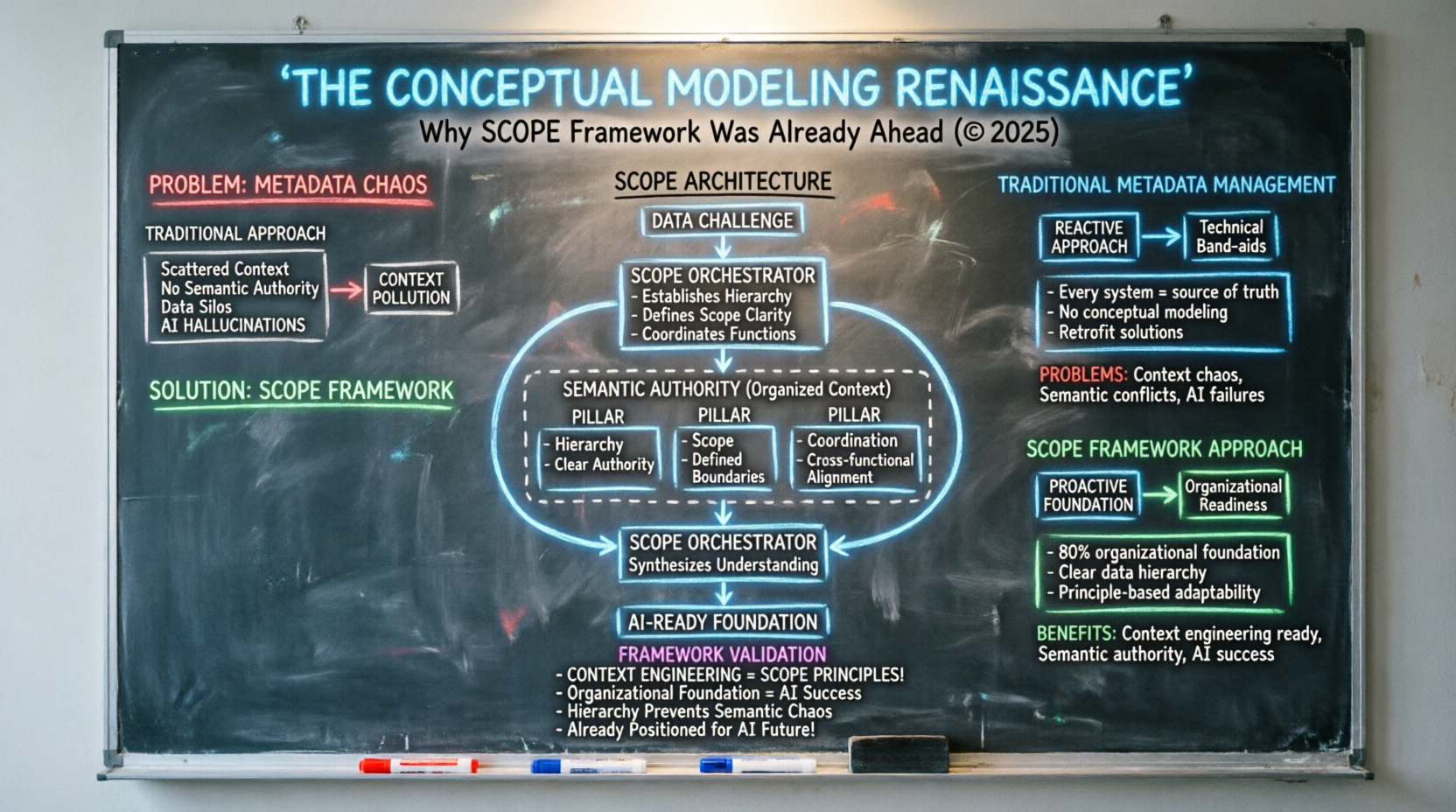
The SCOPE framework anticipated AI's "context problem" by establishing data hierarchy and semantic authority to help the facing these challenges. While others rush to solve AI's semantic chaos, SCOPE already provided the organizational foundations needed for effective context engineering.

I was scrolling through LinkedIn last week when an article caught my attention: "Conceptual Modeling is the Context Engineering We Need for AI" by Juha Korpela. As I read through the passionate argument for reviving conceptual modeling to solve AI's context problem, I felt that familiar mix of validation and irony that comes when the industry "discovers" something you've been advocating for some time.
Juha Korpela made compelling points about how LLMs are forcing us to be explicit about context, how semantic layers are becoming critical, and how we need to dust off those old conceptual modeling techniques. But as I read deeper, I couldn't shake the feeling that this wasn't really a discovery, it was validation.
You see, everything this article was calling for, the emphasis on semantic hierarchy, the need for clear scope boundaries, the recognition that context engineering is fundamentally an organizational challenge, these weren't new insights. They were the core principles that the SCOPE framework had been quietly advocating all along.
It was one of those moments when you realize you've been ahead of a curve you didn't even know existed. While the AI community was rushing to build bigger models and faster retrieval systems, the SCOPE framework was already addressing the foundational question that would eventually break those systems: "Which data do we believe?"
This wasn't just about being right, it was about recognizing that the SCOPE framework had anticipated problems the industry was only now beginning to understand. The conceptual modeling renaissance wasn't happening because old techniques were suddenly relevant again. It was happening because the industry was finally catching up to insights that sophisticated data practitioners had already internalized.
As I closed Korpela's article, I realized this was the perfect moment to examine how the SCOPE framework had been quietly solving the "context problem" long before AI made it fashionable. Sometimes the most advanced thinking doesn't announce itself with fanfare, it just works, waiting patiently for the world to catch up.
The Context Problem: SCOPE Framework Saw It Coming
When AI teams talk about "context engineering," they're essentially grappling with what the SCOPE framework calls data hierarchy, the fundamental question of "which data do we believe?" rather than "where is the data?"
The conceptual modeling advocates are right about one thing: LLMs make context obligatory. But what they're missing is that this problem existed long before AI. The SCOPE framework's approach to data hierarchy recognized that without clear data hierarchy, every system becomes a potential source of truth, creating the semantic chaos that now breaks AI systems.
The Hierarchy-Context Connection
Consider what happens when an AI agent encounters conflicting data definitions across systems:
- Marketing's "Customer" (includes prospects)
- Sales' "Customer" (paying clients only)
- Finance's "Customer" (excludes internal accounts)
This isn't a technical integration problem, it's a data hierarchy problem. The SCOPE framework's emphasis on establishing clear data hierarchy provides the foundation that conceptual modeling needs to be effective. Without hierarchy, conceptual models become just another set of competing definitions.
Scope Clarity: The Missing Piece in Conceptual Modeling Discussions
The SCOPE framework's scope clarity pillar addresses something the conceptual modeling revival largely ignores: the organizational dynamics that determine whether semantic models succeed or fail.
The Scope Trap in Semantic Context
Most conceptual modeling initiatives fail not because of technical limitations, but because of scope ambiguity:
- Who owns the business definitions?
- Which systems must conform to the conceptual model?
- How do you handle legacy systems with embedded semantic assumptions?
- What happens when business concepts evolve?
The SCOPE framework's focus on scope clarity provides the governance foundation that makes conceptual modeling sustainable. Without clear scope boundaries, semantic initiatives become sprawling documentation exercises that nobody maintains.
Advanced Thinking: Scope as Semantic Boundary
The SCOPE framework's approach to scope clarity reveals sophisticated understanding of how semantic context actually works in enterprises. Scope isn't just about project boundaries, it's about semantic boundaries. When you define scope clearly, you're actually defining:
- Which business concepts are in scope for standardization
- Which systems must align to shared semantics
- Which stakeholders have authority over semantic decisions
- How semantic changes propagate through the organization
Data Hierarchy as Semantic Architecture
The SCOPE framework's data hierarchy pillar demonstrates advanced thinking about semantic architecture that goes beyond traditional conceptual modeling approaches.
Beyond Static Models: Living Semantic Hierarchy
Traditional conceptual modeling created static diagrams. The SCOPE framework's data hierarchy concept suggests something more dynamic, a living semantic architecture where:
- Hierarchy Defines Authority: Clear levels of semantic authority prevent the "every system is a source of truth" problem
- Context Flows Downward: Business concepts defined at higher levels provide context for lower-level implementations
- Consistency Emerges: Rather than forcing consistency through documentation, hierarchy creates natural semantic alignment
The Knowledge Plane Insight
What conceptual modeling advocates call the "knowledge plane" is essentially what the SCOPE framework describes as proper data hierarchy implementation. The framework's insight is that you can't manage semantics at the data object level, you need enterprise-level semantic governance.
Cross-Functional Coordination: The Human Side of Semantic Success
The SCOPE framework's emphasis on cross-functional coordination addresses the human dynamics that determine whether conceptual models become living assets or forgotten documentation.
The 80/20 Rule Applied to Semantics
The framework's insight that enterprise data success is "20% technology and 80% people" applies directly to conceptual modeling initiatives. The technical aspects of creating semantic models are straightforward. The challenge is the human coordination required to:
- Align stakeholders around shared definitions
- Resolve semantic conflicts between domains
- Maintain semantic consistency as business evolves
- Ensure AI systems consume authoritative semantic context
Integration: Where Semantic Models Meet Reality
The SCOPE framework's integration pillar reveals why conceptual modeling initiatives often fail to deliver on their promises. Integration isn't just about connecting systems, it's about aligning people, language, and assumptions.
Semantic Integration as Organizational Challenge
The framework recognizes that integration challenges are fundamentally about misaligned assumptions. This insight applies directly to semantic integration:
- Different teams have different mental models of the same business concepts
- Legacy systems embed semantic assumptions that may no longer be valid
- New systems introduce semantic concepts that don't map cleanly to existing models
The SCOPE framework's approach to integration provides the organizational foundation needed to make conceptual models effective across enterprise boundaries.
The Evolutionary Nature of SCOPE: A Living Framework for Dynamic Contexts
One of the most sophisticated aspects of the SCOPE framework is its recognition that data, and the frameworks that govern it, must evolve continuously. Just as AI models require ongoing training and refinement, the SCOPE framework is designed as an adaptive system that evolves with organizational needs and technological advances.
Framework Evolution Mirrors Data Evolution
The SCOPE framework embodies the same evolutionary principles it applies to data management:
- Continuous Learning: Just as AI systems learn from new data, the framework learns from implementation experiences across different organizational contexts
- Adaptive Architecture: The framework's principles remain constant while their implementation adapts to specific company cultures, industries, and technological landscapes
- Contextual Intelligence: Rather than prescribing rigid methodologies, the framework provides intelligent principles that can be contextualized for each organization's unique challenges
Principle-Based Adaptability
The genius of the SCOPE framework lies in its principle-based approach rather than prescriptive methodology. This allows organizations to:
- Adapt Hierarchy Structures: A manufacturing company might implement data hierarchy differently than a financial services firm, but both follow the core principle of establishing clear semantic authority
- Contextualize Scope Boundaries: A startup's scope clarity implementation will differ from an enterprise's, but both benefit from clear semantic boundaries
- Scale Integration Approaches: Small teams might use informal coordination mechanisms while large organizations need formal governance structures, yet both apply the integration principle
- Evolve Governance Models: As organizations mature, their governance approaches can evolve while maintaining the core principle of clear decision-making authority
- Customize Coordination Mechanisms: Cross-functional coordination might happen through daily standups in agile organizations or formal committees in traditional enterprises
Dynamic Framework for Dynamic Challenges
The SCOPE framework's evolutionary nature makes it particularly well-suited for the AI era, where:
- Business Requirements Change Rapidly: AI capabilities evolve quickly, requiring frameworks that can adapt to new use cases and requirements
- Technology Stacks Evolve: New tools and platforms emerge constantly, requiring frameworks that can accommodate technological change without losing semantic consistency
- Organizational Structures Shift: AI initiatives often require new organizational models, and the framework can evolve to support these changes
- Regulatory Landscapes Transform: AI governance requirements are still emerging, and the framework can adapt to incorporate new compliance needs
Implementation Flexibility Within Principled Structure
This evolutionary approach means that two organizations implementing the SCOPE framework might look completely different in practice while achieving the same fundamental outcomes:
- Startup Implementation: Might use lightweight, informal processes with rapid iteration cycles
- Enterprise Implementation: Might require formal governance structures with extensive documentation and approval processes
- Manufacturing Implementation: Might focus heavily on operational data hierarchy and real-time integration
- Financial Services Implementation: Might emphasize compliance-driven governance and risk-based scope definition
Why the SCOPE Framework Was Already AI-Ready
The current excitement about conceptual modeling for AI reveals how prescient the SCOPE framework was. While others focused on technical solutions, the framework identified the organizational and semantic foundations that AI systems actually need.
Advanced Framework Validation
The conceptual modeling renaissance validates several advanced aspects of the SCOPE framework's design principles:
- Hierarchy Over Catalog: The framework's focus on data hierarchy rather than just data cataloging anticipated the need for semantic authority structures
- Scope as Governance: The framework's scope clarity pillar provides the governance foundation that makes semantic consistency achievable
- People-Centric Approach: The framework's emphasis on cross-functional coordination addresses the human dynamics that determine semantic success
- Integration Realism: The framework's integration pillar acknowledges the organizational complexity that semantic initiatives must navigate
- Evolutionary Design: The framework's adaptive nature anticipated the need for continuous evolution in response to technological and organizational change
The Path Forward: SCOPE Framework as Semantic Foundation
The conceptual modeling revival isn't just about bringing back old techniques, it's about implementing them within frameworks sophisticated enough to handle enterprise complexity. The SCOPE framework provides that sophistication.
Implementing Conceptual Modeling Within SCOPE
Rather than treating conceptual modeling as a separate initiative, the SCOPE framework suggests integrating it as:
- Hierarchy Implementation: Use conceptual models to define and document data hierarchy relationships
- Scope Documentation: Leverage conceptual models to clarify semantic scope boundaries
- Integration Planning: Apply conceptual models to identify and resolve semantic integration challenges
- Coordination Tool: Use shared conceptual models as coordination mechanisms for cross-functional teams
- Evolution Mechanism: Treat conceptual models as living documents that evolve with organizational understanding and technological capabilities
The Competitive Advantage of Advanced Thinking
Organizations implementing the SCOPE framework are already positioned to succeed with AI initiatives because they've addressed the foundational challenges that conceptual modeling alone cannot solve.
The framework's advanced thinking about data hierarchy, scope clarity, and cross-functional coordination provides the organizational foundation that makes semantic initiatives sustainable. While others rush to implement conceptual modeling as a technical solution, SCOPE framework adopters understand it as an organizational capability that must evolve continuously.
The Real Innovation
The real innovation isn't in reviving conceptual modeling, it's in implementing it within frameworks sophisticated enough to handle enterprise reality and adaptive enough to evolve with changing needs. The SCOPE framework's focus on hierarchy, scope, integration, governance, and coordination provides exactly that sophistication, while its principle-based approach ensures it can adapt to any organizational context.
Context-Aware Implementation Success
The framework's evolutionary nature means that organizations can:
- Start with their current capabilities and gradually evolve toward more sophisticated implementations
- Adapt the framework to their industry-specific requirements and regulatory constraints
- Scale their implementation as their data maturity and AI capabilities grow
- Maintain consistency of principles while allowing flexibility in execution
The conceptual modeling renaissance validates what the SCOPE framework already knew: successful enterprise data initiatives require organizational foundations that can evolve with changing needs, not just technical solutions. The framework was already AI-ready because it addressed the human and organizational challenges that determine whether semantic context actually works in practice, while providing the evolutionary flexibility needed to adapt to any organizational context.
The convergence of conceptual modeling advocacy and SCOPE framework principles reveals the advanced thinking embedded in the framework. While others are discovering the importance of semantic context for AI, the framework already provided the organizational foundation needed to make that context effective, and the evolutionary flexibility to adapt that foundation to any company's unique context and changing needs.